We Collated Our Own Keyword List. It Got Shorter.
Operator reads of our keywords list: 405 rows (2026-08-05) became 291 (2026-08-20). Token-signature grouped duplicates; similarity folded ahrefs with ahrefs ai.
How TrustGrowth infers E-E-A-T from GSC data: API endpoints, scored dimensions, published uncertainty ranges, and stated limitations — dated 2026-07-28.
Learn what real SEO proof requires: permanent IDs, first-party GSC data, visible weak spots, and machine-readable records — tested on a live register.
A GSC-verified TrustGrowth E-E-A-T audit of trustgrowth.ai, run 2026-07-26, shows a 33.33% authoritativeness pillar. Full method, JSON data, and limits.
A bounded Fix My Site run: audit 614 flagged multiple_h1, a human merged the fix, we re-checked the live page. The live page is the checkable artifact.
Learn how TrustGrowth score works, what it measures, why it changes, and where to verify live proof with timestamps and GSC-backed evidence.
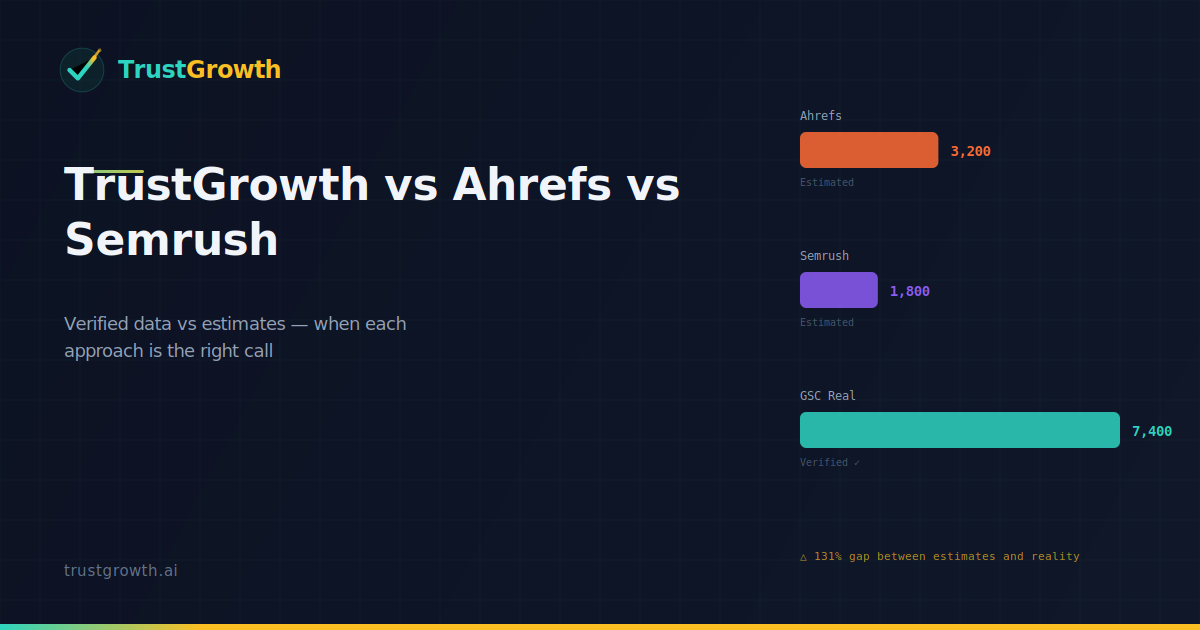
I built TrustGrowth, so I have a bias. But here's a fair comparison: Ahrefs uses estimates. Semrush uses estimates. TrustGrowth uses your real GSC data. Here's when each approach is the right call.
Ravi Yadav
·
March 25, 2026
·
6 min
Every SEO tool I used was making up numbers. Ahrefs said 3,200 visits. Semrush said 1,800. GSC said 7,400. So I built a tool that only uses real data.
Ravi Yadav
·
March 19, 2026
·
4 min