ACT ONE · MEASURE · AUTHORITY
Authority isn't a number someone sells you.
It's who links to you, who cites you, and whether any of it survives inspection.
REAL OUTPUT · DATED SOURCES · NO DA-EQUIVALENT
DOMAIN AUTHORITY: 34
no date · no source list
methodology proprietary
REFERRING DOMAINS: 130 ↑8
captured 2026-07-31 · source: DataForSEO backlink snapshot
every domain listed, dated, and diffed in-app
A score cannot answer “says who?”
Somewhere right now, a dashboard is telling a founder their “domain authority is 34.” One number, no date, no sources, computed by a company that has never crawled their market. The founder writes it in a deck.
The difference isn't the number — it's what you can do when someone asks “says who?” One answer has a date, a named source, and a list you can open. The other has a trademark.
Vendor scores measure something; they just won't tell you what, or when, or from where. Evidence answers all three, and lets you disagree with it.
Authority work runs in lanes
Each lane produces evidence you can act on — not a score to chase:
THE LANES
- profile
- referring domains, who they are, how that changed — dated snapshots, deltas per period
- reclamation
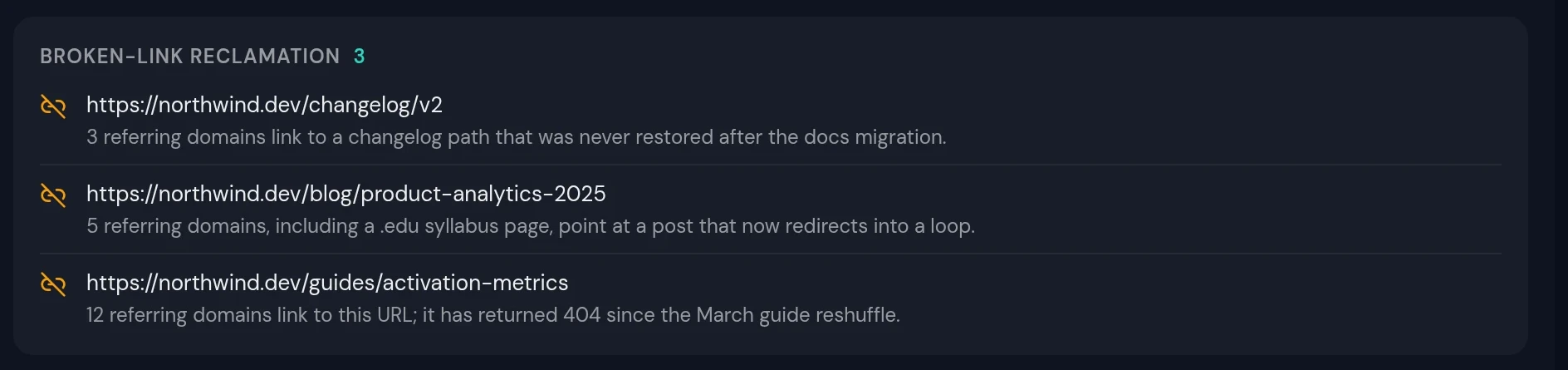
- links you already earned that point at broken targets; the cheapest authority work there is, no outreach required
- link gap
- domains linking to competitors you track, not to you — with the reason they linked
- linkable assets
- what on your site is citable, and what gap a new asset would fill
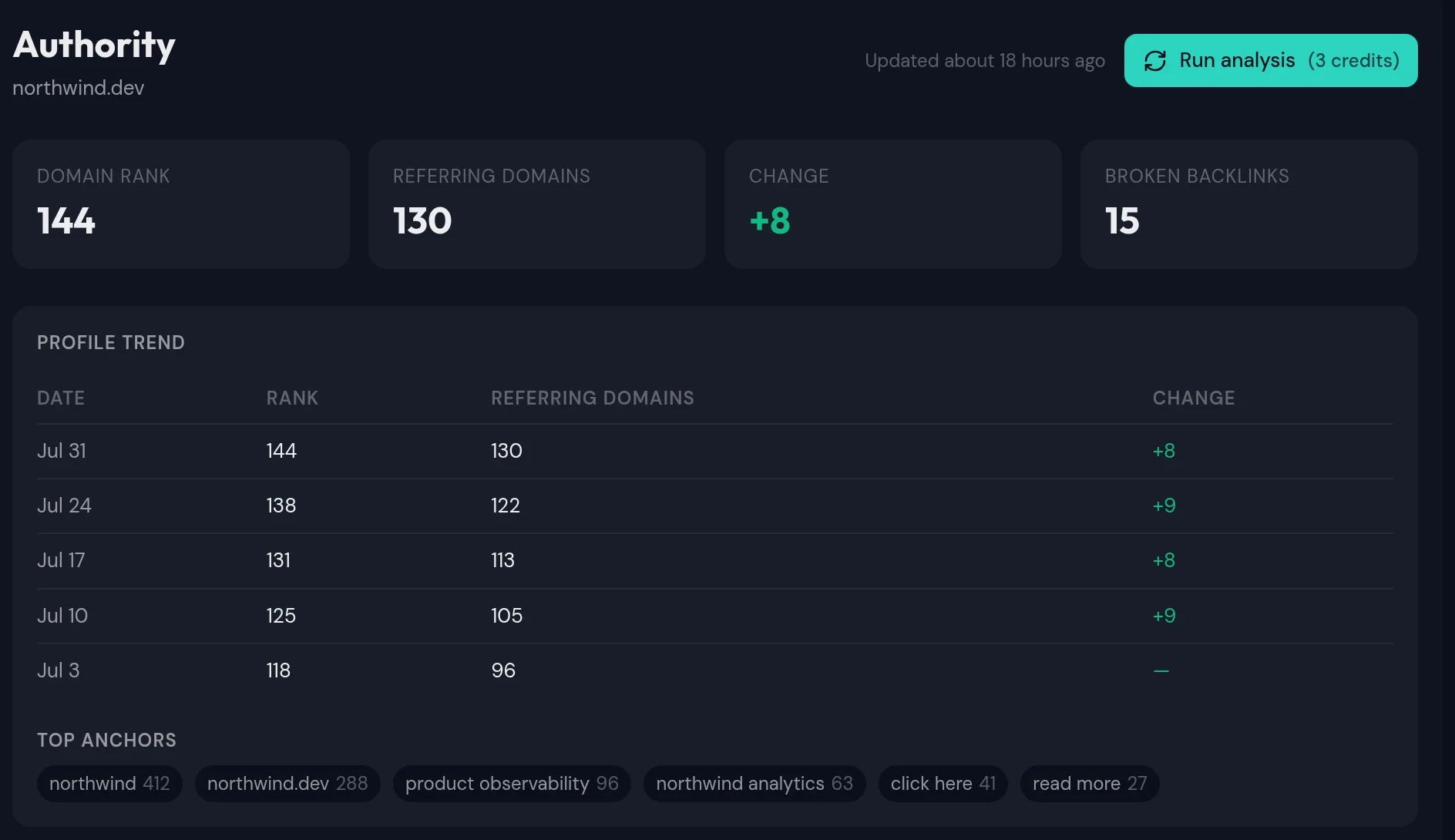
Four lanes, one rule: a row you can't trace to a dated source doesn't render. Missing data appears as “—”, never zero.
TOXIC BACKLINKS: 23
Fix now →
broken target: /guides/activation-metrics
12 referring domains · 404 since the March guide reshuffle
fix: one redirect
One of these creates fear and sells a disavow feature. The other is a redirect you can commit this afternoon.
Hard edges, on purpose
The authority lanes have hard edges, and they're part of the product, not fine print:
- No anonymous toxicity verdicts
- “Toxic” is a vendor opinion we report only with the vendor's name on it.
- No automated disavow
- Google says most sites should never use the tool, and misuse hurts.
- Human review for suspicious links
- We will show you the link and the evidence; a person decides.
- No bought links, exchanges, or private networks
- Earned or nothing.
Where the line falls
- Free
- monthly signals — authority signals inside your score and E-E-A-T breakdown.
- Starter · $9
- weekly signals · lanes locked until Pro — the same signals on a weekly cadence, alongside competitor tracking.
- Pro · $49
- all four lanes · full history — backlink snapshots, reclamation, link gap and linkable assets, with history behind every delta.
WHAT THIS DOES NOT SAY
Backlink data is a third-party index observation — no index sees every link, and every profile figure here carries its provider and date. Authority scores from other tools are opinions about the same evidence; we don't convert between them, imitate them, or grade against them — there is deliberately no DA-equivalent here.
Frequently asked questions
Do you give a domain authority score?
No. There is deliberately no DA-equivalent here, and we do not convert to one, imitate one, or grade against one. What you get instead is the evidence a score would have been computed from: referring domains, who they are, and how that changed — each figure dated and source-labelled.
Where does the backlink data come from?
A third-party backlink index, named on the figure, with the date of the snapshot it came from. No index sees every link, so every profile number here is an observation with provenance rather than a total.
What is broken-link reclamation?
Links you already earned that now point at a broken target on your own site. It is the cheapest authority work there is — no outreach, usually one redirect — and the product shows the broken URL, how many domains link to it, and why it broke.
Do you offer disavow or toxic-link removal?
No automated disavow, ever. Google's own guidance is that most sites should never use that tool, and misuse causes damage. "Toxic" is a vendor opinion, so we report it only with the vendor's name attached, show you the link and the evidence, and leave the decision to a person.
Do you build, buy or exchange links?
No. No bought links, no exchanges, no private networks. Earned or nothing. What the product does instead is show which domains link to competitors you track and not to you, and what on your site is worth citing.
What is a link gap?
A domain that links to a competitor in your tracked set but not to you, shown with the reason it linked. It is a list of places where a link has already been earned by somebody for a reason you can read — not a prospecting database.
What do I get on Free?
Authority signals inside your score and E-E-A-T breakdown. The four lanes — profile, reclamation, link gap, linkable assets — with the history behind every delta, are Pro.
Get my score
Your authority file starts with what's verifiable today — which may be smaller than a vendor score suggested, and will be real.